
The Rise of Cobots in Industrial Automation
Understanding Collaborative Robots (COBOTS)
The New Factory Floor
For over a century, industrial automation meant robots in cages — powerful, precise, and utterly off-limits to the humans working nearby. That model served manufacturing well. But it also came with hard limits: inflexibility, enormous footprints, steep programming barriers, and a wall of steel separating machine intelligence from human ingenuity.
Collaborative robots — cobots — break that wall down. Designed from the ground up to work alongside people in shared workspaces, cobots represent a fundamental rethinking of what automation can look like. They’re not replacing human workers. They’re teaming up with them.
The result is a technology segment growing at an extraordinary pace. The global cobot market reached $3.06 billion in 2025 and is on track to hit $22.61 billion by 2035, expanding at a compounded annual rate of 22%. This isn’t incremental progress — it’s a structural shift in how the world makes things.
“Cobots are not the robots of science fiction — they are practical, programmable partners deployed on the line today, in factories of every size and sector.”
This article explores what cobots are, how they differ from traditional industrial robots, which industries are adopting them fastest, the forces driving that adoption, and where the technology is headed next.
What Exactly Is a Cobot?
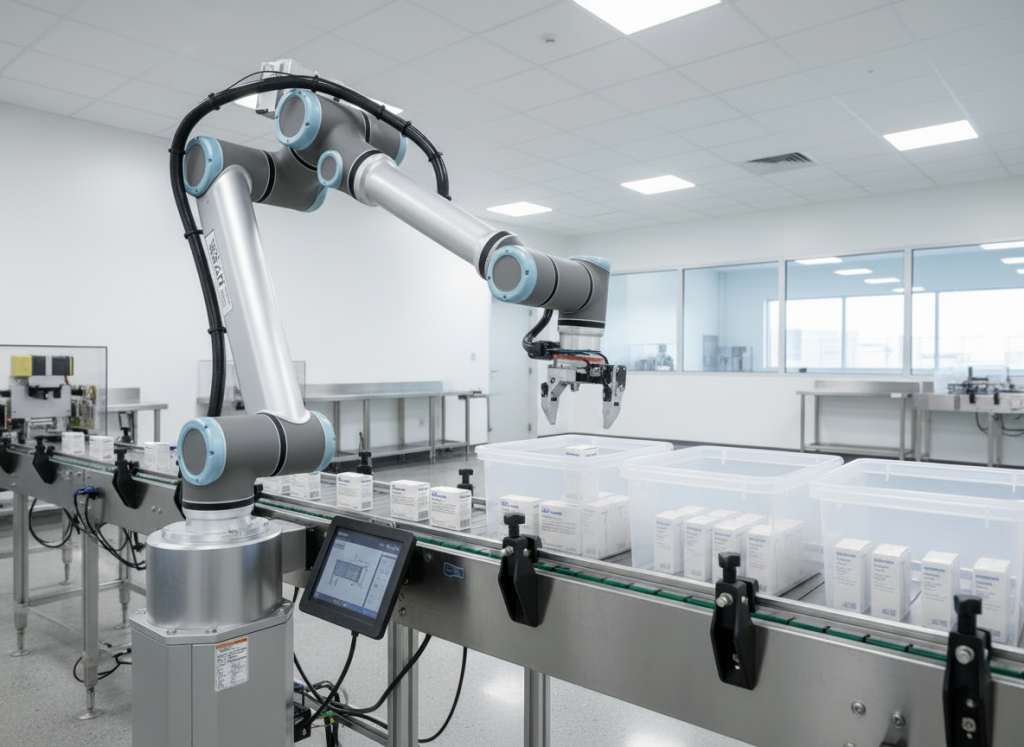
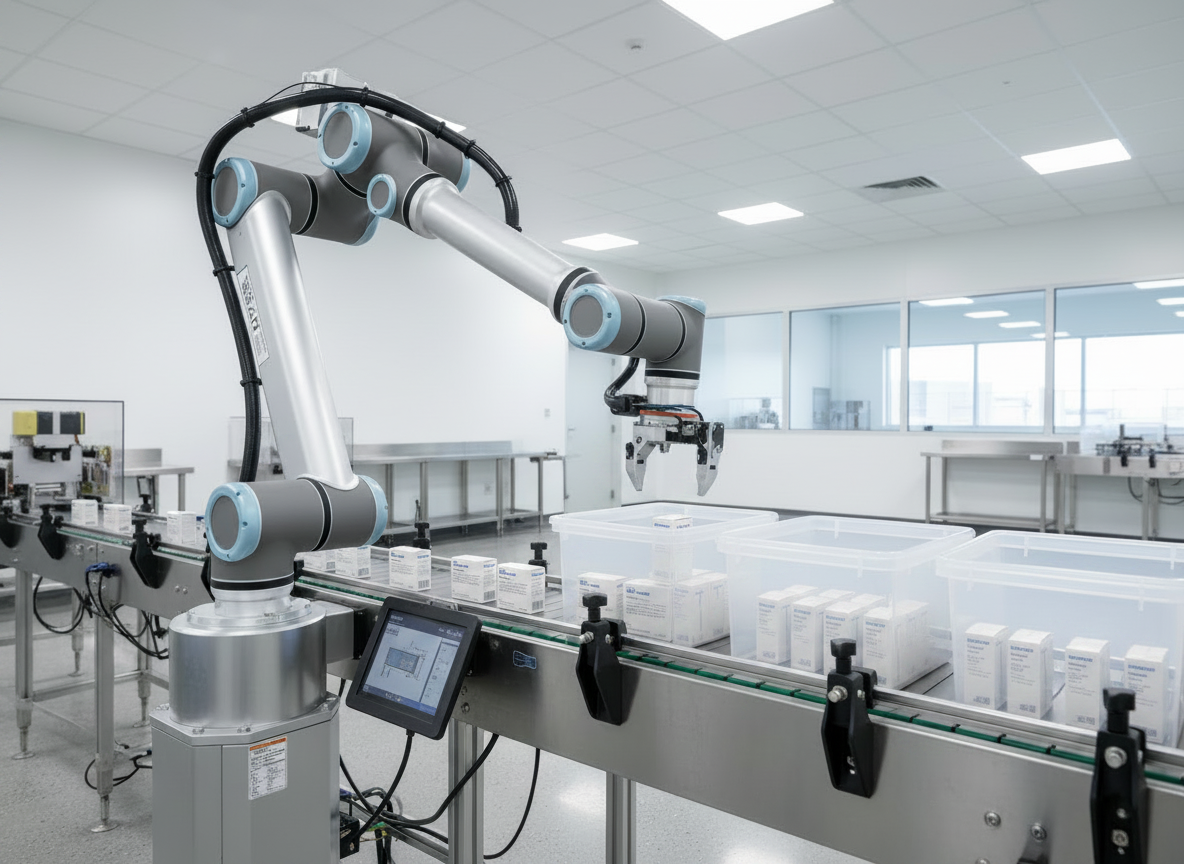
A collaborative robot is a robotic system explicitly engineered to detect the presence of humans and operate safely in close proximity to them — without the safety fencing that traditional industrial robots require. That definition sounds simple, but it hides a great deal of sophisticated engineering.
Cobots achieve safe human-robot collaboration through a combination of force-torque sensing, speed and separation monitoring, power and force limiting, and increasingly, computer vision systems that can track human movement in real time and react accordingly. Many modern cobots will slow down, redirect, or halt entirely the moment a human enters their operating envelope.
Key Characteristics
Human-Safe by Design Built-in force limiting and collision detection allow direct physical interaction without injury risk — no safety cage required.
Modular & Flexible Interchangeable end-effectors and modular components let manufacturers rapidly redeploy cobots across different tasks and production lines.
Easy Programming Hand-guided teach modes and graphical interfaces mean a skilled operator — not a robotics engineer — can program most cobots in hours.
Small Footprint Compact designs slot into existing floor layouts without facility redesign, making cobots viable for space-constrained environments.
Low Power Draw Cobots consume a fraction of the energy of traditional industrial robots, supporting sustainability goals and reducing operating costs.
IoT-Connected Modern cobots integrate with MES, ERP, and cloud platforms, enabling remote monitoring, predictive maintenance, and real-time analytics.
These characteristics make cobots particularly attractive to small and medium-sized enterprises (SMEs) — a segment historically priced out of industrial robotics. The lower capital barrier, ease of programming, and flexibility mean an SME can automate a process today and redeploy that same cobot to a different task next quarter.
Why the Surge — and Why Now?
The cobot boom isn’t accidental. Several structural forces have converged to make collaborative automation not just appealing but, for many manufacturers, operationally necessary.
The Labor Shortage Crisis
Across developed economies, manufacturing is struggling with a workforce gap that grows wider each year. The U.S. alone faces a deficit of approximately 400,000 welders. Europe reported over 200,000 vacancies in the construction sector in 2020, a number that has grown since. Meanwhile, younger generations are showing declining interest in factory work, and aging workforces are retiring faster than replacements can be trained.
Cobots address this directly. They handle the repetitive, ergonomically taxing, or hazardous elements of a job — freeing the human workforce to focus on tasks requiring judgment, dexterity, and creativity. This isn’t automation displacing labor; it’s automation making the remaining labor sustainable.
Industry 4.0 & Smart Factory Integration
The broader Industry 4.0 movement — digitizing and networking the factory floor — has created fertile soil for cobot adoption. Today’s cobots don’t just perform tasks; they generate data. They log cycle times, flag deviations, report maintenance needs, and feed information into factory management systems that orchestrate production in real time.
As manufacturers invest in smart factory infrastructure, cobots become natural nodes in an interconnected production network — not isolated machines but participants in a data-driven manufacturing ecosystem.
AI & Vision Advancements
Artificial intelligence is transforming cobot capability at an accelerating pace. Machine vision systems now allow cobots to identify, orient, and handle objects they’ve never encountered in training. Reinforcement learning enables them to optimize task sequences autonomously. Predictive maintenance algorithms use sensor data to flag component wear before failures occur.
These advances are closing the gap between cobots and traditional industrial robots on precision and speed — while preserving the collaborative safety profile that defines the category.
Where Cobots Are Being Deployed
Cobots have moved well beyond pilot programs. Today they are embedded in production operations across a wide range of industries, performing tasks that range from the highly precise to the purely repetitive.
Industries currently deploying cobots: Automotive · Electronics · Food & Beverage · Healthcare · Logistics · Metalworking · Semiconductor · Plastics · Aerospace · EV Battery
Automotive & Metalworking
Automotive and metalworking facilities account for approximately 43% of cobot installations globally. In automotive plants, cobots perform spot welding assistance, torque-critical fastening, dashboard assembly, quality inspection, and parts handling — often working station-to-station alongside human assemblers. Their ability to apply consistent, calibrated force makes them ideal for tasks where human fatigue introduces variability.
Electronics & Semiconductor
Roughly 70% of electronics and automotive production units now integrate cobots for enhanced safety and task flexibility. In electronics, cobots excel at placing fragile components, soldering, testing, and packaging — tasks where consistent precision across millions of cycles outperforms even the most skilled human operator. Semiconductor applications demand higher precision than current cobot technology delivers in all cases, but rapid advancement is narrowing this gap.
Logistics & E-Commerce
The e-commerce explosion has driven aggressive automation in fulfillment. More than 52% of logistics and e-commerce warehouses in the U.S. now use collaborative robots for sorting, packing, and material handling. The flexibility of cobots — able to switch between SKUs without retooling — makes them uniquely well-suited to the variable, high-mix environment of modern fulfillment operations.
Food, Beverage & Packaging
Food-safe cobots handle pick-and-place, portioning, labeling, palletizing, and quality inspection. Their ability to operate in cold environments, be sanitized between runs, and work safely alongside food handlers without contamination risk makes them increasingly preferred over traditional automation in this sector.
Healthcare
Cobots are entering operating rooms and clinical labs. Applications include surgical assistance, pharmacy dispensing, rehabilitation therapy, and laboratory sample handling. The human-safe design philosophy is not incidental here — it’s the entire point.
Most Common Task Categories
- Pick & Place — 78% of deployments
- Inspection / Quality Control — 62%
- Assembly — 55%
- Palletizing — 47%
- Machine Tending — 41%
- Welding Assistance — 34%
Challenges & Considerations
Cobots are powerful tools, but they are not a universal solution. Manufacturers considering adoption should enter with clear eyes about both the opportunity and the genuine limitations.
Speed Limitations Cobots operate at reduced speeds compared to traditional industrial robots — a deliberate safety constraint. For high-throughput applications where cycle time is paramount, this can be a limiting factor. Mitigation: Hybrid deployment — cobots for collaborative tasks, traditional robots for high-speed isolated processes — allows manufacturers to capture the benefits of both without compromise.
Payload Constraints Most cobots are optimized for light payload applications. Heavy lifting, large-part handling, and high-force operations remain outside the practical envelope of most collaborative systems. Mitigation: Payload capacities are increasing with each product generation. Heavy-duty collaborative systems rated for 35+ kg are entering the market, expanding viable applications significantly.
Ultra-Precision Tasks Semiconductor fabrication and similar micron-level precision requirements currently exceed what most cobots can reliably deliver. Mitigation: Advances in AI-driven calibration and closed-loop vision control are steadily improving cobot precision. Dedicated high-precision collaborative systems are already available for specialized applications.
Integration Complexity Integrating cobots into legacy production environments — older MES systems, non-standard tooling, complex part geometries — can require significant engineering effort. Mitigation: Standardized interfaces, growing ecosystems of plug-and-play peripherals, and specialist integrators are reducing time-to-deployment even in complex environments.
The Road Ahead
The cobot category is not standing still. Several technology trends are converging to expand what collaborative robots can do — and who can benefit from them.
AI-Native Cobots
The next generation of cobots will be trained rather than programmed. Instead of laboriously specifying every motion path, operators will demonstrate a task a handful of times and the robot will generalize from those demonstrations — adapting to variations in part orientation, environmental conditions, and edge cases autonomously. This capability, already emerging in leading platforms, will dramatically reduce deployment time and expand the range of tasks accessible to automation.
Predictive Maintenance & Connected Services
IoT integration enables cobots to continuously monitor their own health — bearing wear, joint temperatures, motor current profiles — and flag maintenance needs before failures occur. This proactive approach reduces unplanned downtime, extends robot lifecycle, and lowers total cost of ownership. Remote monitoring also allows manufacturers to manage cobot fleets across multiple facilities from centralized operations centers.
Increasing Modularity
A major design trend for 2025 and beyond is growing modularity. Cobots are increasingly built around standardized interfaces that allow rapid configuration changes — swapping end-effectors, adding sensors, reconfiguring joint configurations — to meet shifting production demands. For manufacturers operating in high-mix, low-volume environments, this flexibility is transformative.
Sustainability Integration
Cobots contribute directly to sustainability goals through low energy consumption, reduced material waste from higher process consistency, and support for lean manufacturing principles. As ESG reporting requirements tighten globally, the energy efficiency profile of cobots becomes an additional argument in their favor.
Industry 5.0: Humans & Machines Together
Industry 4.0 was about connecting machines. Industry 5.0 is about integrating human creativity, judgment, and values into automated production systems. Cobots are the physical embodiment of this philosophy — systems designed not to replace human workers but to amplify their capabilities. Research into human-robot interaction is deepening, with focus on cognitive as well as physical collaboration: cobots that understand context, anticipate human intentions, and adapt their behavior accordingly.
“The future factory isn’t lights-out automation. It’s a dynamic collaboration between human skill and machine precision — and cobots are the bridge.”
The Case Is Clear
Collaborative robots have crossed the threshold from emerging technology to established industrial tool. The market data is unambiguous: a compound annual growth rate above 22%, adoption across every major manufacturing vertical, and an overwhelming majority of surveyed businesses planning to expand their cobot footprint in the coming years.
The drivers are structural, not cyclical. Labor shortages won’t reverse. Demand for manufacturing flexibility won’t ease. The economic argument for cobots — faster ROI than traditional automation, lower integration costs, adaptability across tasks — will only strengthen as technology matures and costs continue to fall.
For manufacturers still evaluating whether cobots belong in their operations, the relevant question is no longer if — it’s where to start. The most successful implementations begin with a focused pilot: a high-repetition, ergonomically challenging, or quality-critical task where the value of consistent, tireless precision is immediately measurable. From there, the data tends to make the case for expansion on its own.
The factory floor is being reimagined. Cobots aren’t a disruption to that process — they’re the mechanism through which it happens.