
In modern manufacturing and distribution environments, efficiency depends on maintaining consistent product flow throughout every stage of production. While palletizing systems are responsible for organizing products for storage and shipment, depalletizers play an equally important role by automating the process of unloading products from pallets and feeding them into production lines. The integration of Depalletizers in Industrial Automation is crucial for optimizing these processes.
Depalletizing systems help manufacturers reduce manual labor, improve throughput, and maintain reliable product handling across high-volume operations. From food and beverage facilities to warehousing and packaging environments, depalletizers have become essential tools for improving operational efficiency and supporting continuous production, especially through Depalletizers in Industrial Automation.
As industries face increasing labor shortages and higher production demands, automation is becoming a necessary investment rather than an optional upgrade. Automated depalletizing systems, a key component of Depalletizers in Industrial Automation, allow facilities to reduce repetitive handling tasks while creating safer, faster, and more scalable workflows.
Modern depalletizers now incorporate advanced robotics, conveyor integration, machine vision, and intelligent controls that allow them to handle a wide range of products with greater flexibility and accuracy than ever before.
What Is a Depalletizer?
A depalletizer is an automated system designed to remove products from pallets and transfer them into downstream operations such as conveyors, packaging equipment, assembly systems, or production lines.
The system unloads products layer by layer while maintaining controlled product flow and minimizing handling damage.
Depalletizers are commonly used for:
- Boxes and cartons
- Bottles and cans
- Bags and sacks
- Consumer packaged goods
- Food and beverage products
- Agricultural packaging
- Industrial materials
Once products are removed from the pallet, they are transferred into production processes such as filling, packaging, labeling, sorting, or assembly operations.
Automating this process improves efficiency while reducing the physical demands associated with manual unloading.
Types of Depalletizers in Industrial Automation
Robotic Depalletizers
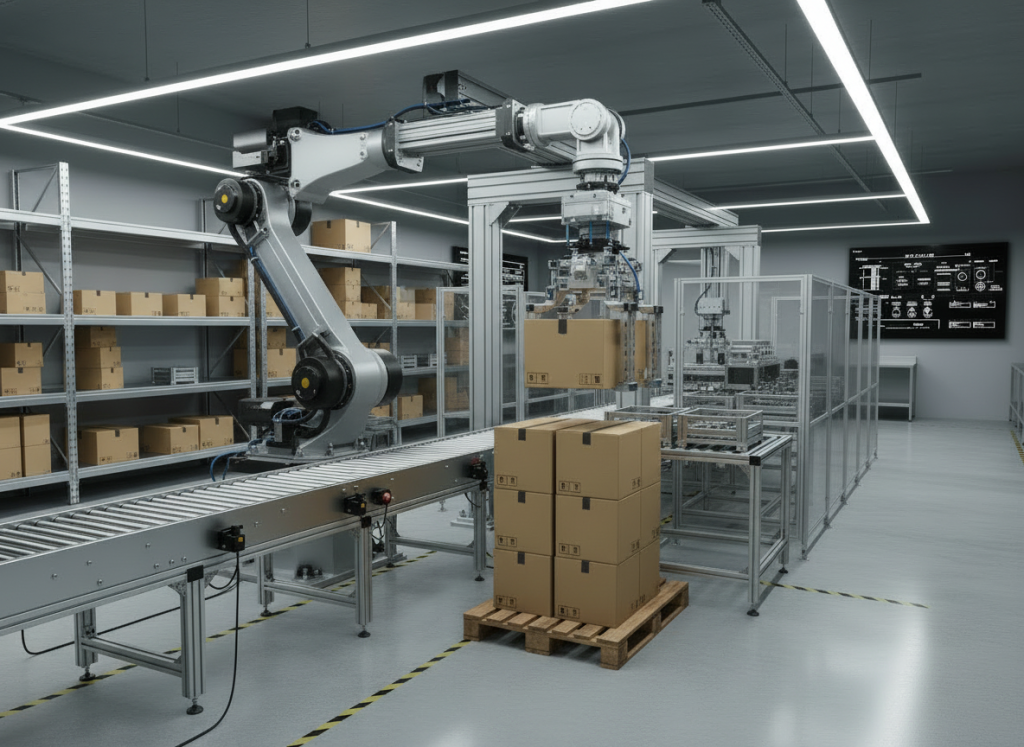
Robotic depalletizers are among the most flexible and widely used systems in industrial automation.
These systems typically use 6-axis industrial robots equipped with specialized end-of-arm tooling to remove products from pallets and place them onto conveyors or transfer systems.
Benefits of robotic depalletizers include:
- Flexible product handling
- Multiple pallet pattern capability
- Easier changeovers
- Compact system design
- Scalable automation solutions
Because robotic systems can adapt to different product sizes and pallet layouts, they are ideal for facilities handling multiple SKUs or varying packaging formats.
The Role of Depalletizers in Industrial Automation
Conventional depalletizers use mechanical systems designed to unload products in predefined patterns.
These systems are often used in high-speed production environments where pallet configurations remain consistent.
Conventional systems may include:
- Layer sweep mechanisms
- Elevating platforms
- Product transfer tables
- Automated layer handling equipment
While highly efficient in predictable applications, conventional depalletizers generally offer less flexibility than robotic solutions.
Gantry Depalletizers
Gantry depalletizers use overhead Cartesian or gantry-style robotic systems to unload products from pallets across large work areas.
These systems are commonly used for:
- Heavy product handling
- Large pallet loads
- Multi-line production systems
- High payload applications
Their rigid structure and extended reach make them highly effective for depalletizers in industrial automation operations.
Benefits of Automated Depalletizing
Increased Throughput
One of the biggest advantages of automated depalletizing is improved production efficiency.
Manual unloading processes often create bottlenecks that slow down upstream and downstream operations. Automated systems maintain consistent cycle times and continuous product flow, helping facilities increase throughput and reduce interruptions.
Benefits include:
- Faster unloading speeds
- Reduced production downtime
- Continuous product feeding
- Improved line efficiency
- Stable operational performance
High-speed depalletizing systems can operate continuously across multiple shifts while maintaining reliable product handling.
Reduced Manual Labor
Depalletizing is physically demanding work that often involves repetitive lifting, bending, and twisting motions.
Automating these tasks reduces labor dependency while minimizing physical strain on employees.
Facilities implementing depalletizers in industrial automation often see improvements in:
- Labor allocation
- Worker fatigue reduction
- Employee retention
- Operational consistency
- Overall workplace efficiency
Rather than eliminating jobs, automation allows workers to focus on higher-value responsibilities such as quality control, maintenance, and process oversight.
Improved Workplace Safety
Manual depalletizing can expose workers to repetitive motion injuries and lifting-related strain.
Automated systems improve workplace safety by reducing direct interaction with heavy products and repetitive handling tasks.
This is especially important in industries involving:
- Heavy cases or containers
- High production volumes
- Fast-paced production lines
- Repetitive lifting operations
Reducing physical strain contributes to safer work environments and more sustainable production operations.
Consistent Product Handling
Automated depalletizers improve consistency by maintaining controlled movement throughout the unloading process.
This reduces:
- Product damage
- Misalignment issues
- Conveyor jams
- Handling inconsistencies
Consistent product flow improves downstream equipment performance and helps maintain stable production output with depalletizers in industrial automation.
Key Components of a Depalletizing System
Industrial Robots
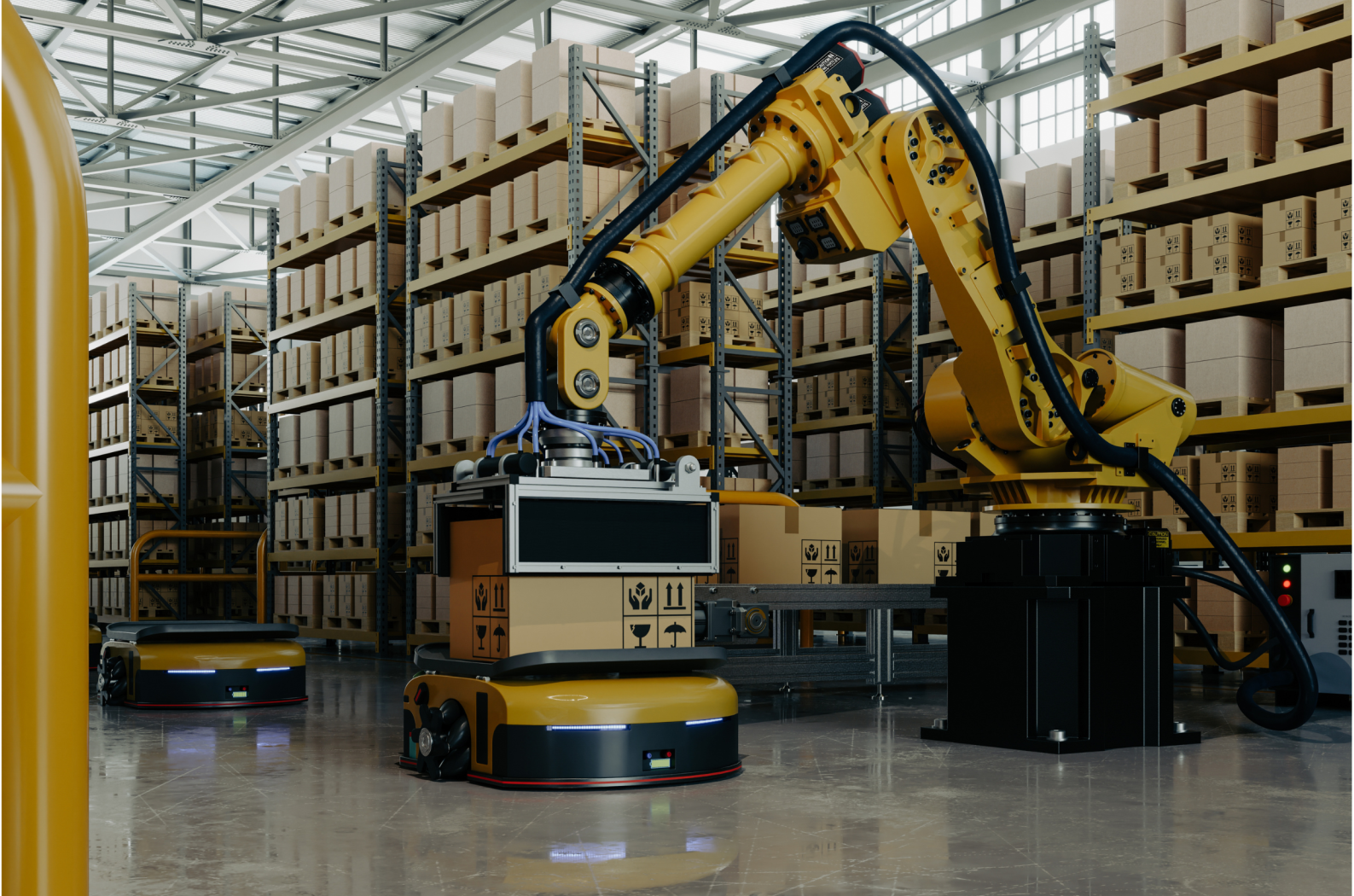
Most modern robotic depalletizers use 6-axis industrial robots because of their flexibility and wide range of motion.
These robots provide:
- Multi-angle movement
- Flexible pallet access
- Precise product placement
- Reliable repeatability
- Adaptability for different pallet patterns
Robot selection depends on payload requirements, throughput goals, and product handling needs.
End-of-Arm Tooling (EOAT)
The EOAT is the interface between the robot and the product being handled.
Common depalletizing tooling options include:
- Vacuum grippers
- Clamp-style tooling
- Fork tooling
- Layer grippers
- Combination handling tools
Proper tooling design is critical for handling reliability, cycle speed, and product protection.
Custom tooling is often developed to match the specific packaging and product requirements of the application.
Conveyor Systems
Conveyors manage product transfer between the depalletizer and downstream equipment.
Integrated conveyor systems may include:
- Product alignment sections
- Accumulation zones
- Product spacing controls
- Pallet transfer conveyors
Proper conveyor integration helps maintain smooth and efficient production flow.
Vision Systems
Modern depalletizers frequently incorporate machine vision systems to improve flexibility and handling accuracy.
Vision systems allow robots to:
- Identify product position
- Detect pallet alignment
- Verify layer configuration
- Adapt to shifted or damaged loads
- Guide robotic movement in real time
This reduces the need for perfectly staged pallets and improves overall system reliability.
Common Depalletizing Applications
Food and Beverage Processing
Food and beverage manufacturers frequently use depalletizers to unload cans, bottles, cartons, and packaged products into filling or packaging lines.
Automation helps maintain continuous product flow while reducing labor-intensive unloading processes.
Common applications include:
- Beverage can depalletizing
- Bottle handling
- Dairy product transfer
- Packaged food processing
High-speed systems are especially important in fast-moving production environments and can be accomplished with depalletizers in industrial automation.
Agricultural Processing
Agricultural facilities use depalletizers for handling packaged produce, egg cartons, feed products, and other palletized materials.
Automation improves efficiency while reducing handling damage in sensitive packaging applications.
Consumer Packaged Goods (CPG)
CPG manufacturers often manage a wide variety of product formats and packaging configurations.
Robotic depalletizers provide flexibility for:
- Multiple SKUs
- Changing pallet patterns
- Seasonal production changes
- Mixed product handling
This flexibility allows facilities to maintain efficient operations while adapting to changing market demands.
Warehouse and Distribution Operations
Distribution centers increasingly use depalletizing automation to improve product flow and order fulfillment speed.
Automation supports:
- Faster unloading operations
- Improved inventory handling
- Reduced labor-intensive transfer processes
- Greater operational consistency
As warehouse automation continues expanding, depalletizers are becoming more common in logistics environments.
Integration with Existing Production Lines
One of the key advantages of modern depalletizing systems is their ability to integrate with existing production equipment.
Depalletizers can communicate directly with:
- Conveyors
- Packaging machines
- Filling systems
- Labeling equipment
- Warehouse management systems
- PLC control systems
Automation integrators typically design systems around current workflows, floor space limitations, and production goals to minimize operational disruption.
Depalletizers in industrial automation allows manufacturers to improve efficiency without completely redesigning their facilities.
The Future of Depalletizing Automation
Depalletizing technology continues evolving alongside broader advancements in industrial automation.
Modern systems increasingly incorporate:
- AI-assisted vision systems
- Real-time production analytics
- Predictive maintenance monitoring
- Collaborative robotics
- Smart conveyor coordination
- Remote diagnostics and support
Depalletizers in industrial automation are helping facilities create more connected and adaptive production environments capable of responding to changing operational demands.
Final Thoughts
Automated depalletizers have become essential tools for manufacturers and distribution facilities seeking greater efficiency, consistency, and scalability.
By automating repetitive unloading tasks, depalletizing systems help facilities improve throughput, reduce labor dependency, and maintain stable product flow throughout production operations.
Whether used in food processing, agriculture, manufacturing, or logistics environments, depalletizing automation provides a reliable and long-term solution for handling increasing production demands while improving workplace safety and operational performance.
As industrial automation continues advancing, depalletizers will remain a critical component of efficient and scalable production systems.