
Automation continues to change the way manufacturers move, pack, and palletize products. One of the most versatile technologies helping companies automate these processes is the robotic vacuum gripper.
For efficient handling, a robotic vacuum gripper is essential in modern automation systems. This technology enhances productivity and reduces labor costs.
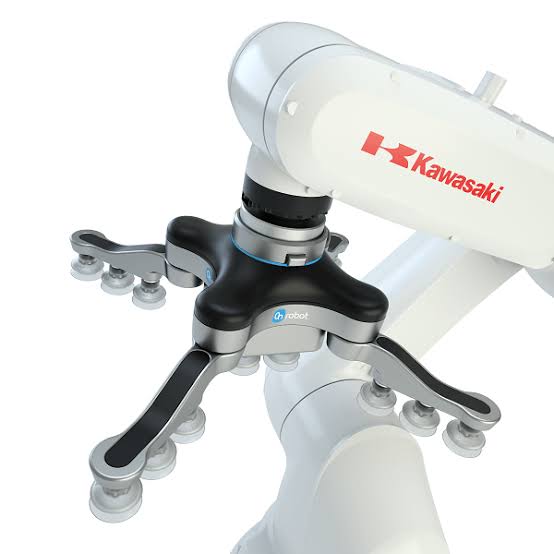
A robotic vacuum gripper is suitable for various tasks, from delicate handling of packaged goods to robust lifting of heavy items.
Vacuum grippers allow an industrial robot to pick up and move products using suction rather than traditional mechanical fingers or clamps. When paired with a high-performance industrial robot, vacuum gripping can provide fast, repeatable handling for everything from boxes and bags to sheets, cartons, and packaged products.
Understanding the role of a robotic vacuum gripper is critical for optimizing your automation processes.
With a robotic vacuum gripper, manufacturers can significantly enhance their operational efficiency.
At SynerTech Automation, we exclusively use Kawasaki Robotics for our robotic automation systems. Kawasaki offers a broad range of industrial robots, including high-speed palletizing robots designed for demanding material-handling applications.
Utilizing a robotic vacuum gripper allows for seamless integration into existing production lines.
What Is a Robotic Vacuum Gripper?
Implementing a robotic vacuum gripper can lead to higher precision in material handling tasks.
A vacuum gripper is a type of end-of-arm tooling (EOAT) attached to the end of a robot arm.
Rather than gripping a product from the sides, the tool creates a vacuum between the gripper and the product’s surface. Suction cups, foam pads, or other vacuum interfaces create the connection that allows the robot to lift, move, and place the product.
A complete vacuum EOAT system can include:
- Vacuum cups or foam pads
- Vacuum generators or pumps
- Valves
- Tubing and fittings
- Sensors
- A mounting plate or custom tooling
- The robot itself
The specific configuration depends heavily on the product being handled. A rigid cardboard box, for example, may require a very different gripping solution than a porous bag or irregularly shaped package.
Learn more about vacuum EOAT and gripper technology from Vacuforce.
Why Use a Vacuum Gripper With a Robot?
The biggest advantage of vacuum gripping is versatility.
Mechanical grippers need to physically contact a product in a particular way. Vacuum grippers, on the other hand, can often pick a product directly from its top surface. This makes them particularly useful for applications where products need to be picked quickly and placed accurately.
Some common applications include:
This technology’s adaptability makes the robotic vacuum gripper a favorite among manufacturers.
Each robotic vacuum gripper can be customized to meet specific application needs.
Palletizing
A robotic vacuum gripper is versatile enough for both light and heavy-duty applications.
In palletizing, a robotic vacuum gripper can efficiently position products for optimal stacking.
Choosing the right robotic vacuum gripper can greatly influence your workflow outcomes.
Robotic palletizing is one of the most common applications for vacuum grippers.
A robot can pick cases, cartons, bags, or other packaged products from a conveyor and place them onto a pallet according to a programmed pattern.
For depalletizing tasks, a robotic vacuum gripper is invaluable for maintaining speed and efficiency.
Kawasaki’s palletizing robot lineup includes models ranging from approximately 80 kg to 700 kg of payload capacity, allowing systems to be designed around a wide range of product weights and production requirements.
Explore Kawasaki’s palletizing robot lineup.
Depalletizing
The use of a robotic vacuum gripper simplifies the pick-and-place operations significantly.
Vacuum grippers are also useful when products need to be removed from pallets.
Depalletizing can be particularly challenging when product positions aren’t perfectly consistent. Vision systems can be incorporated into the automation system to identify products and help the robot determine where and how to pick them.
The Association for Advancing Automation has highlighted robotic palletizing and depalletizing systems that combine Kawasaki Robotics, vacuum gripping, and 3D vision technology.
Shapes and sizes of products can vary, but a robotic vacuum gripper adapts to these changes effortlessly.
Pick and Place
Vacuum grippers are commonly used to move products from one location to another.
For example, a Kawasaki robot may pick products from a conveyor, orient them, and place them into boxes, trays, packaging, or another production process.
Kawasaki offers dedicated pick-and-place robots as well as general-purpose industrial robots for a variety of material-handling applications.
Handling Bags and Flexible Products
Not every product has a perfectly rigid, flat surface.
Bags, sacks, pouches, and other flexible products can require specialized vacuum tooling. Foam grippers and specially designed vacuum systems can provide a larger gripping surface when conventional suction cups aren’t ideal.
Vacuforce, for example, offers vacuum tooling specifically designed for applications involving bags and sacks as well as robotic palletizing.
Choosing the Right Vacuum Gripper
The robot is only one part of a successful robotic handling system.
The vacuum gripper needs to be matched to the product and the application.
Several factors should be considered:
Product Weight
The heavier the product, the more gripping force the system needs.
The robot’s payload also needs to account for the weight of the end-of-arm tooling itself—not just the product being moved.
Surface Material
The product’s surface has a major impact on vacuum performance.
Smooth, non-porous surfaces are generally easier to grip with traditional suction cups. Porous materials such as cardboard, paper bags, or certain fabrics may require specialized cups, foam, or other tooling.
Product Shape
Flat products are often relatively straightforward to grip. Irregular or flexible products may require custom tooling with multiple vacuum zones or specialized gripping surfaces.
Speed and Cycle Time
A gripper that works perfectly at a slow speed may not perform the same way when the robot is operating at high speed.
Acceleration, deceleration, product weight, and the amount of vacuum available all need to be considered when designing the system.
Product Variation
If your production line handles multiple products, the gripper may need to accommodate differences in size, shape, weight, and surface characteristics.
Modern vacuum tooling can be designed with multiple suction points or vacuum zones to provide greater flexibility.
The Association for Advancing Automation notes that newer foam-based vacuum tooling can help palletizing systems handle a broader range of non-uniform products.
Why We Choose Kawasaki Robots
At [Company Name], we don’t try to make every robot brand fit every application.
We use Kawasaki Robotics.
Kawasaki has a long history in industrial robotics and offers robots designed specifically for applications such as palletizing, material handling, picking, and other manufacturing processes.
For palletizing applications, Kawasaki’s current lineup includes high-speed models such as the CP series, with payload capacities extending up to 700 kg.
That range allows us to select the Kawasaki robot that best fits the application instead of forcing the application to fit the robot.
Kawasaki also provides robots across a wide range of payloads and applications, from small and medium-sized general-purpose robots to large industrial and palletizing robots.
Our approach is simple: the robot and the gripper need to work together as one system.
The Robot Is Only Half of the Solution
It’s easy to focus on the robot when discussing automation.
But the robot itself doesn’t actually pick up the product.
That’s the job of the end-of-arm tooling.
The gripper determines how the product is contacted, how much gripping force is available, how quickly the product can be picked, and how reliably it can be released.
This is why proper EOAT design is so important.
Schmalz, a major manufacturer of vacuum automation technology, describes EOAT as the critical connection between the robot and the workpiece and offers vacuum, magnetic, and mechanical gripping technologies for different applications.
With its flexibility, a robotic vacuum gripper is perfect for diverse production environments.
For more information about end-of-arm tooling, Schmalz’s EOAT guide is a useful resource.
Custom Vacuum Grippers vs. Off-the-Shelf Solutions
Applications for a robotic vacuum gripper include everything from food packaging to electronics assembly.
There isn’t necessarily one “best” vacuum gripper.
The right solution depends on the application.
An off-the-shelf suction cup system may work perfectly for a straightforward application. More complicated applications may require a custom-designed tool with multiple suction cups, vacuum zones, sensors, or specialized foam.
For example, Vacuforce’s modular vacuum tooling can be configured around the product’s size, weight, surface, orientation, and robot requirements.
That’s where an experienced automation integrator can make a significant difference.
Instead of simply attaching a gripper to a robot, the entire system can be evaluated—including the product, conveyor, robot, tooling, vacuum source, cycle time, safety requirements, and production goals.
Is a Vacuum Gripper Right for Your Application?
A vacuum gripper may be a strong option if your application involves:
- Boxes or cartons
- Bags or sacks
- Packaged food products
- Cases
- Sheets or panels
- Products that need to be palletized
- Products that need to be depalletized
- High-speed pick-and-place
- Repetitive material handling
- Multiple product sizes or configurations
However, vacuum isn’t automatically the right answer for every application.
Product surface, weight, shape, porosity, production speed, and environmental conditions all matter.
The best way to determine the right solution is to evaluate the complete application—not just the robot or gripper independently.
Ready to Automate Your Material Handling Process?
Evaluating whether a robotic vacuum gripper is suitable for your application is essential for success. A robotic vacuum gripper can transform a repetitive material-handling process into a faster, more consistent, and more scalable operation.
Investing in a robotic vacuum gripper will enhance your operational capabilities over time. Each robotic vacuum gripper comes with features that can be tailored to fit specific industries. By incorporating a robotic vacuum gripper into your operations, you can streamline workflows and reduce waste.
And when the right vacuum tooling is paired with the right Kawasaki industrial robot, the result can be a highly capable automation system designed around your specific production needs.
At [Company Name], we specialize in robotic automation using Kawasaki Robotics. If you’re considering robotic palletizing, depalletizing, pick-and-place, or another material-handling application, we’d be happy to evaluate your process and determine whether a Kawasaki robot with vacuum end-of-arm tooling is the right solution.
[Contact us to discuss your automation application]