
When manufacturers need to automate the repetitive movement of parts, products, or components, the right end-of-arm tooling can make all the difference.
One of the most common and versatile options is the mechanical robot gripper.
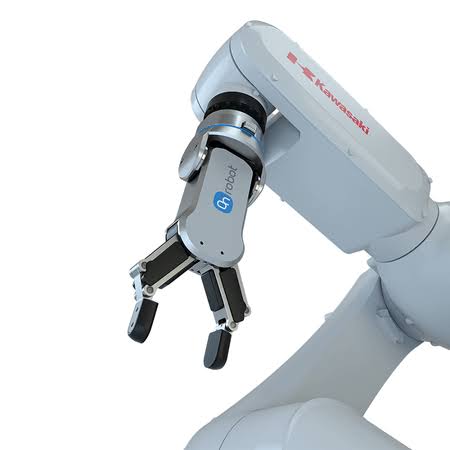
Mechanical robot grippers use physical fingers or jaws to securely hold a workpiece as a robot moves it from one location to another. Unlike vacuum grippers, which rely on suction and a suitable surface, mechanical grippers physically engage with the part. This makes them an excellent choice for many applications involving rigid, irregular, porous, or precisely positioned components.
At SynerTech Automation, we design and integrate complete robotic automation systems using Kawasaki Robotics. As a Kawasaki Robotics preferred integrator, our team combines robotic technology with application-specific engineering, programming, tooling, and system integration.
What Is a Mechanical Robot Gripper?
A mechanical gripper is a type of end-of-arm tooling (EOAT) attached to the wrist of an industrial robot.
Think of it as the robot’s hand.
The robot provides the movement and positioning, while the gripper interacts directly with the product or workpiece. The gripper opens, closes, and applies force to securely hold the part during movement.
The Association for Advancing Automation (A3) describes end-of-arm tooling as the equipment attached to a robot that interacts directly with workpieces. The tooling is what allows a general-purpose robot to perform a specific task such as picking, placing, manipulating, or assembling a part.
Mechanical grippers can be pneumatic, electric, or specially engineered for a particular application.
Common configurations include:
- Two-finger parallel grippers
- Three-finger grippers
- Angular grippers
- Custom mechanical tooling
- Multi-part grippers
- Servo-controlled grippers
The right configuration depends on the product, process, required cycle time, and manufacturing environment.
How Do Mechanical Gripper Robots Work?
A typical robotic mechanical gripping sequence is straightforward:
- The Kawasaki robot moves into position.
- The mechanical gripper robot approaches the workpiece.
- The mechanical gripper robot’s fingers or jaws close around the part.
- Sensors can confirm that the part has been successfully gripped.
- The robot moves the part to its next location.
- The mechanical gripper robot releases the part.
- The robot repeats the process.
Although the basic concept is simple, designing a reliable system requires much more than simply selecting a gripper.
The gripper, robot payload, tooling weight, part geometry, robot motion, cycle time, sensors, and control system all need to work together.
That’s where robotic system integration becomes important.
Types of Mechanical Robot Grippers
There isn’t one mechanical gripper that works for every application.
Different designs provide different advantages.
Two-Finger Parallel Grippers
Two-finger parallel grippers are among the most common mechanical grippers used in industrial automation.
Two opposing fingers move toward one another to clamp the workpiece.
They are well suited for parts with predictable gripping surfaces and are frequently used for:
- Machine tending
- Pick-and-place
- Assembly
- Part transfer
- Packaging
- Material handling
Parallel grippers can grip a part from the outside or, depending on the design, expand inside a bore or opening to grip the part internally.
Three-Finger Grippers
Three-finger mechanical gripper robots provide three points of contact around a workpiece.
This configuration can be particularly useful for cylindrical or round components because the fingers can help center the part as they close.
Common applications include handling:
- Cylindrical components
- Round machined parts
- Shafts
- Tubes
- Other rotationally symmetric components
Angular Grippers
Angular grippers use fingers that pivot as they open and close rather than moving straight toward one another.
This can be useful when the robot has limited access around a part or when the application requires a particular approach angle.
Angular grippers are commonly considered for applications involving irregular geometries, restricted access, or parts with features that make a conventional parallel grip difficult.
When Should You Use a Mechanical Gripper?
Mechanical gripper robots are particularly useful when a vacuum gripper isn’t the best fit for the product.
For example, mechanical gripping may be preferable when:
The Product Is Porous
Vacuum systems require an appropriate seal to generate sufficient holding force.
Materials such as certain fabrics, porous packaging, unfinished wood, or other difficult-to-seal surfaces can make vacuum gripping challenging.
A mechanical robot gripper doesn’t depend on creating a vacuum seal.
The Part Has an Irregular Shape
Mechanical fingers can be designed around the geometry of a part.
Custom fingers can provide contact points specifically positioned for the workpiece, allowing a robot to securely handle shapes that would be difficult to pick with standard vacuum tooling.
Precise Positioning Is Important
Mechanical gripping can provide a defined physical relationship between the gripper and the workpiece.
For applications where the part needs to be presented in a repeatable orientation, properly designed mechanical tooling can provide a reliable reference point.
The Robot Is Moving Quickly
Robot motion doesn’t stop at the pickup.
The workpiece needs to remain secure while the robot accelerates, decelerates, rotates, and changes direction.
Gripper selection therefore needs to account for the forces created during the entire robot motion—not simply the static weight of the part.
Festo notes that gripping reliability is influenced by factors including workpiece geometry, robot motion, acceleration, tolerances, environmental conditions, and contact design.
Mechanical vs. Vacuum Grippers
So, which is better: a mechanical gripper or a vacuum gripper?
The answer is it depends on the application.
Vacuum grippers can be excellent for products with suitable surfaces, especially boxes, cartons, sheets, and other products that can be reliably picked from the surface.
Mechanical grippers can be a better option when the product has a difficult surface, irregular geometry, or a defined location where the gripper can physically engage the part.
Neither technology is universally better.
The right question is:
Which gripping method provides the most reliable and efficient way to move your specific product?
At SynerTech Automation, we look at the entire application before determining the appropriate robotic tooling.
Mechanical Grippers and Kawasaki Robots
At SynerTech Automation, we exclusively use Kawasaki Robotics for our robotic systems.
Kawasaki industrial robots are used across a wide range of manufacturing applications, including material handling, machine tending, assembly, palletizing, and other automated processes.
That means the robot is selected based on the application—and the mechanical gripper is engineered to work with the robot as part of the complete system.
This distinction is important.
A gripper isn’t simply an accessory added to a robot after the fact.
The robot and end-of-arm tooling need to be considered together.
The weight and dimensions of the gripper affect robot payload and motion. The position of the tooling affects the robot’s reach and inertia. The gripping method affects cycle time and part handling. Sensors and controls affect how the system detects successful grips and responds to errors.
The goal isn’t simply to make a robot pick up a part.
The goal is to create a reliable production system that performs that task thousands of times.
Applications for Mechanical Gripper Robots
Mechanical gripper robots can be used across a wide range of manufacturing and automation applications.
Machine Tending
Robots can use mechanical grippers to load and unload CNC machines, presses, and other manufacturing equipment.
A Kawasaki robot can retrieve a raw part, load it into a machine, remove the completed component, and transfer it to the next stage of production.
This can reduce repetitive manual handling while allowing operators to focus on higher-value tasks.
Pick and Place
Mechanical grippers can move individual components between conveyors, fixtures, machines, bins, and other workstations.
The robot can perform the same movement repeatedly with consistent timing and positioning.
Assembly
Mechanical grippers can hold components while they are positioned, assembled, or transferred to another operation.
Depending on the application, tooling can be designed to handle multiple components or accommodate multiple part variations.
Material Handling
From individual components to larger industrial parts, mechanical grippers can provide a reliable method for transferring products throughout a manufacturing process.
Packaging
Mechanical grippers can also be incorporated into automated packaging systems when products require physical gripping rather than vacuum handling.
What Goes Into Designing a Robotic Gripper System?
Selecting the gripper is only one part of the engineering process.
At SynerTech Automation, a robotic application needs to be evaluated as an entire system.
Important considerations include:
Part weight
How heavy is the product or component?
Part geometry
Where can the gripper safely and reliably make contact?
Surface characteristics
Is the part smooth, oily, hot, porous, fragile, or otherwise difficult to grip?
Robot speed
How quickly does the part need to be moved?
Cycle time
How many parts need to be handled per minute or hour?
Grip force
How much force is required to prevent the part from slipping during movement?
Robot payload
Does the robot have enough capacity for both the part and the complete end-of-arm tooling?
Part variation
Will the system handle one part or multiple sizes and configurations?
Sensors and feedback
How will the system know that the part has been successfully picked?
Production environment
Will the system operate around heat, coolant, dust, oil, moisture, or other environmental factors?
These details can dramatically affect the design of the final automation system.
A3 similarly recommends considering factors such as part geometry, weight, cycle time, positioning accuracy, and environmental conditions when selecting end-of-arm tooling.
Pneumatic vs. Electric Mechanical Grippers
Mechanical grippers can be powered in different ways.
Pneumatic Grippers
Pneumatic grippers use compressed air to open and close their fingers.
They are widely used in industrial environments because they can provide fast actuation and relatively simple control.
They can be particularly effective for high-speed applications where compressed air is already available.
Electric Grippers
Electric grippers use an electric motor or actuator to control the gripping motion.
Depending on the design, electric grippers can offer greater control over position, speed, and gripping force.
This can be useful for applications involving multiple part sizes, frequent changeovers, or applications where more detailed feedback is beneficial.
The choice between pneumatic and electric gripping should be based on the application—not simply on which technology is newer.
Why End-of-Arm Tooling Matters
The robot arm gets most of the attention in a robotic automation system.
But the end-of-arm tooling is what actually interacts with the product.
As Automation World explains, EOAT is a critical factor in robotic automation because the tooling affects efficiency, reliability, and safety.
A powerful robot with poorly designed tooling won’t produce a reliable automation system.
Likewise, the right gripper paired with the right Kawasaki robot can turn a repetitive manual process into a highly consistent automated operation.
That’s why SynerTech approaches robotic automation as a complete engineering project rather than simply selling a robot.
Why Work With SynerTech Automation?
SynerTech Automation is a full-service robotic and industrial automation integrator.
Our team provides engineering, design, programming, system assembly, installation, and support for robotic automation systems.
As a Kawasaki Robotics preferred integrator, we specialize in building automation solutions around Kawasaki robots and designing the supporting equipment—including end-of-arm tooling—to fit the application.
Our goal is to create systems that work in the real world.
That means considering the product, process, robot, gripper, controls, safety requirements, production environment, and future needs together.
Is a Mechanical Gripper Right for Your Application?
If you’re currently relying on operators to repeatedly pick, move, load, unload, or position parts, robotic automation may be worth exploring.
A mechanical gripper robot could be a strong solution if your application involves:
- Repetitive part handling
- CNC machine tending
- Pick-and-place operations
- Assembly
- Material transfer
- Packaging
- Loading and unloading
- Consistent part orientation
- High-volume production
- Labor-intensive handling processes
The best place to start isn’t with a specific robot or gripper.
Start with the application.
What are you moving? How heavy is it? How quickly does it need to move? Where can it be gripped? How often does the part change? What does the production process need to accomplish?
Once those questions are answered, the right robot and tooling can be engineered around the process.
Ready to Automate Your Part Handling?
Mechanical gripper robots can provide reliable, repeatable handling for a wide range of industrial applications.
When the right mechanical gripper is paired with the right Kawasaki robot and integrated into a properly engineered automation system, manufacturers can automate repetitive tasks while improving consistency, throughput, and production efficiency.
SynerTech Automation can help determine what that system should look like.
Whether you’re considering your first robotic application or looking to improve an existing automation process, our team can evaluate your application and develop a solution around your production goals.
Contact SynerTech Automation to discuss your robotic automation application →