
In manufacturing, the packaging process is just as important as the product itself. Once a product has been manufactured, it needs to be organized, protected, packaged, and prepared for distribution. When these final steps rely heavily on manual labor, they can become a bottleneck that slows down the entire production line.
That’s where industrial automation comes in.
Automated box, tray, and case packing systems help manufacturers streamline end-of-line operations, improve consistency, and handle increasing production demands. With the right robotic technology, companies can create more efficient packaging processes while reducing repetitive manual tasks.
At SynerTech Automation, we understand that every product and production line has unique requirements. Whether you’re packaging consumer goods, food products, or industrial components, the right automation solution can make a meaningful difference in your operation.
What’s the Difference Between Box, Tray, and Case Packing?
Although these packaging methods share similarities, each serves a different purpose within manufacturing and distribution.
Box Packing
Box packing involves placing individual products or grouped items into boxes for protection, storage, or shipment. Automated box packing systems can organize products, position them correctly, and load them into packaging with repeatable movements.
This process is commonly used for household products, personal care items, electronics, and other consumer goods.
Tray Packing
Tray packing places products into open or partially enclosed trays, often for display, transportation, or additional packaging.
Automated tray packing systems can arrange products into predetermined patterns and place them into trays with consistent positioning.
This method is especially useful for bottled beverages, packaged foods, containers, and products that need to remain organized during handling.
Case Packing
Case packing typically involves loading multiple products or smaller packages into larger shipping cases.
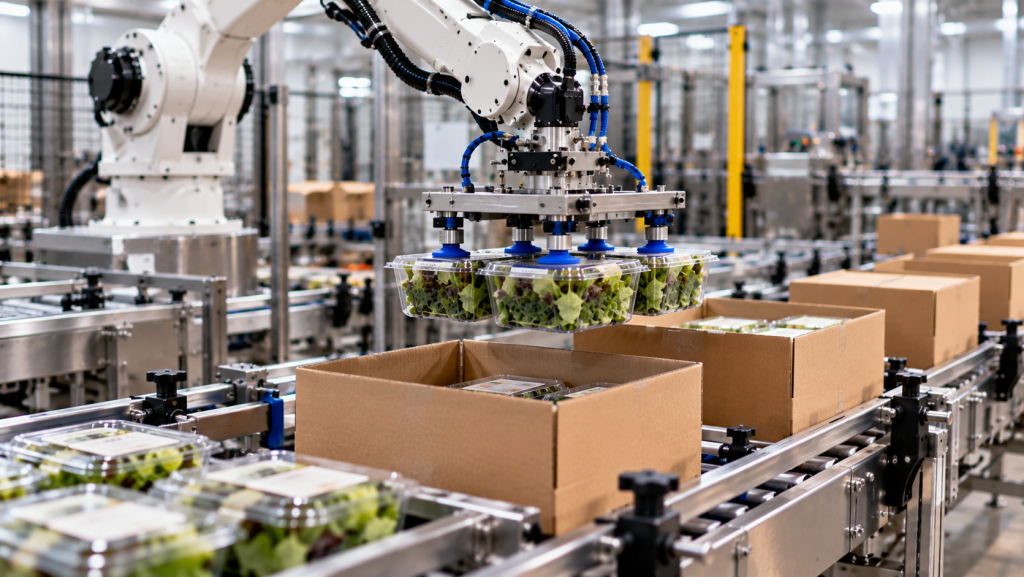
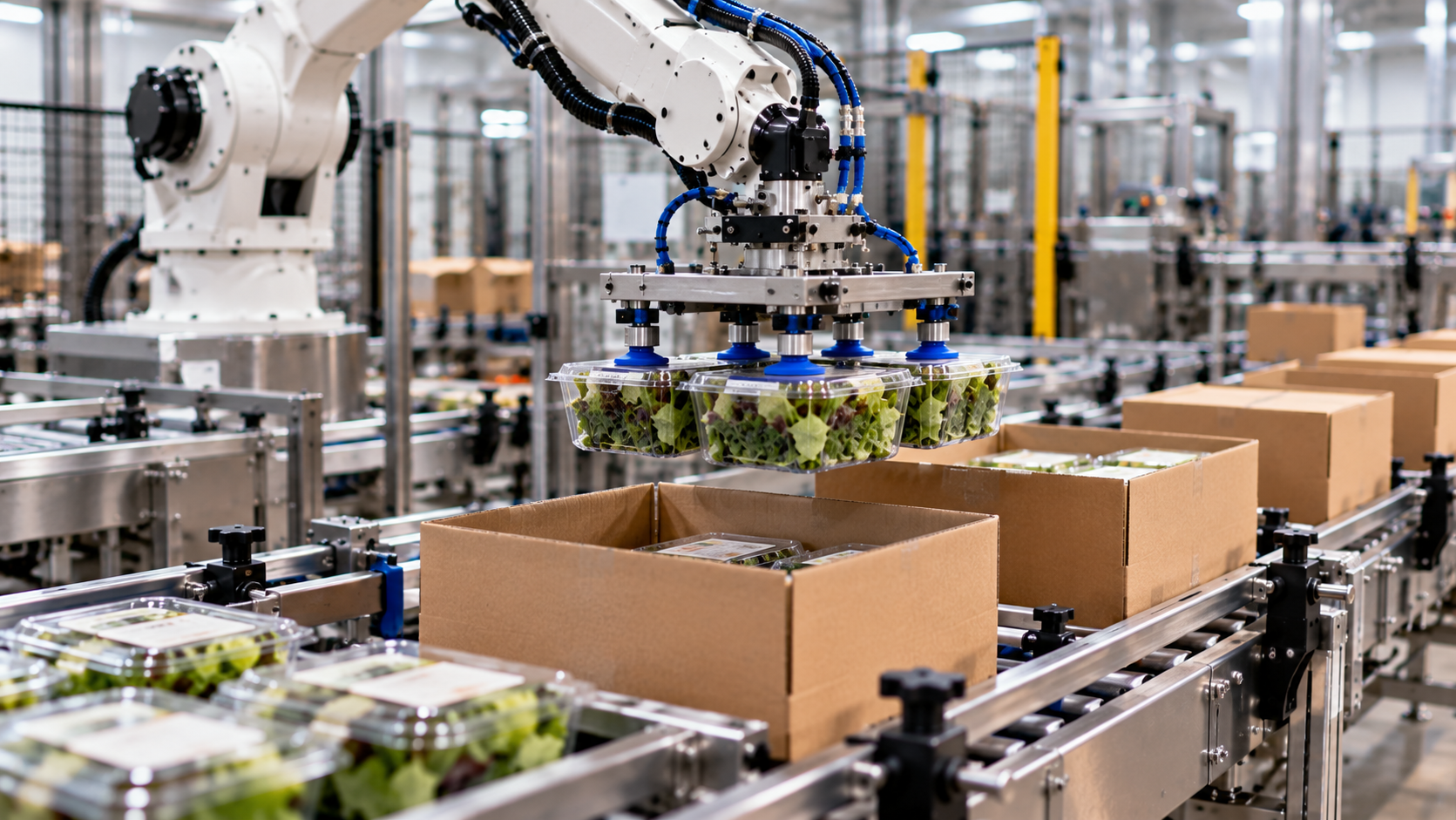
Robotic Case Packing uses industrial robots and specialized gripping equipment to pick up products and place them into cases according to a programmed packing pattern.
This process helps prepare products for palletizing, warehousing, and distribution while reducing the amount of manual handling required.
How Does Automated Packing Work?
Automated packing systems combine several technologies to move products from the production line into their final packaging.
Products typically travel along a conveyor to a designated packing station. Sensors or machine vision systems may identify product positions, orientations, or other characteristics.
A robotic arm or automated handling mechanism then picks up the products using application-specific end-of-arm tooling. Depending on the product, this tooling may include vacuum cups, mechanical grippers, or custom handling equipment.
The system places products into boxes, trays, or cases according to a programmed arrangement.
Once filled, packages can continue to downstream operations such as sealing, labeling, inspection, and palletizing.
The advantage of this approach is that multiple packaging steps can be coordinated within a connected production system.
Five Benefits of Automating Box, Tray, and Case Packing
1. Improved Production Throughput
Manual packing operations can struggle to maintain consistent speeds, especially as production volumes increase.
Automated systems can perform repetitive movements at controlled cycle times, helping manufacturers maintain a steadier packaging process.
When properly engineered around upstream and downstream equipment, robotic packing can help reduce bottlenecks and improve overall line efficiency.
2. Reduced Repetitive Manual Labor
Packing products into boxes or trays often requires employees to repeat the same movements throughout their shifts.
Automation can take over many of these repetitive handling tasks, allowing employees to focus on equipment operation, quality oversight, maintenance, and other responsibilities.
It can also help reduce exposure to repetitive lifting and handling demands.
3. Greater Packing Consistency
Inconsistent product placement can lead to packaging problems, damaged products, and interruptions further down the production line.
Automated packing equipment follows programmed movements and placement patterns, helping products remain consistently positioned.
This repeatability is particularly valuable when packaging products that require precise orientation or organized arrangements.
4. Flexibility Across Different Products
Many manufacturers produce multiple product sizes, packaging configurations, and SKUs on the same production line.
Modern Robotic Case Packing systems can be designed to accommodate product variation through programmable settings, adjustable tooling, and integrated vision systems.
Depending on the application, this flexibility can reduce the amount of manual adjustment needed during product changeovers.
Industry organization PMMI highlights flexibility and SKU variety as important considerations in packaging automation.
5. Better Integration With End-of-Line Operations
Packing is rarely the final step in a manufacturing process.
Once products are packed, they may need to be sealed, labeled, inspected, stacked, and transported.
Integrating packing equipment with conveyors, robotic palletizers, and automated controls helps coordinate these operations.
Rather than treating each machine as a separate process, manufacturers can develop a connected end-of-line packaging system.
Which Industries Benefit From Automated Packing?
Box, tray, and case packing automation can support a wide range of manufacturing environments.
Food and Beverage: Automated systems can handle packaged snacks, bottled beverages, cartons, and other finished products. Equipment selection should account for sanitation and product-handling requirements.
Consumer Products: Household cleaners, personal care products, cosmetics, and retail goods can benefit from consistent packing and flexible handling systems.
Manufacturing and Industrial Products: Components, hardware, and other manufactured items can be organized and packed for storage or shipment.
Warehouse and Distribution: Integrated packaging equipment can help prepare products for palletizing and movement through distribution operations.
Across these industries, the right solution depends on product characteristics, production requirements, and facility layout.
Is Robotic Packing Right for Your Facility?
Before investing in automated packing equipment, manufacturers should evaluate several important factors.
Start by looking at current production volumes and the number of products packed per minute. Identify where delays occur and whether manual packing is limiting the performance of upstream equipment.
Next, consider product characteristics. Size, weight, shape, packaging material, and fragility all influence the type of robot and gripping equipment required.
It’s also important to evaluate available floor space, the number of SKUs being handled, and how frequently production changes between products.
Finally, consider the financial impact.
A well-planned automation investment should account for equipment costs, labor allocation, maintenance, expected throughput improvements, and long-term operational goals.
For additional examples of automation applications across manufacturing, explore the Association for Advancing Automation’s robotic case studies.
Why Choose SynerTech Automation?
At SynerTech Automation, we believe successful packaging automation starts with understanding the complete production process.
Our team develops robotic automation solutions tailored to the requirements of each application, including product handling, custom end-of-arm tooling, conveyors, controls, and equipment integration.
Rather than focusing on a single machine, we consider how the entire system works together.
From high-volume packaging operations to facilities managing multiple product variations, we help manufacturers explore automation solutions designed around their production goals.
Whether you’re considering Robotic Case Packing, automated tray loading, or a more connected end-of-line packaging system, SynerTech can help you evaluate the possibilities.
Take the Next Step Toward Smarter Packaging
Box, tray, and case packing may be among the final steps in production, but they can have a significant impact on overall efficiency.
By automating repetitive packing processes, manufacturers can improve consistency, support higher production demands, and create more flexible operations.
Ready to see what packaging automation could look like in your facility?
Contact SynerTech Automation to discuss your project and request a custom quote.