
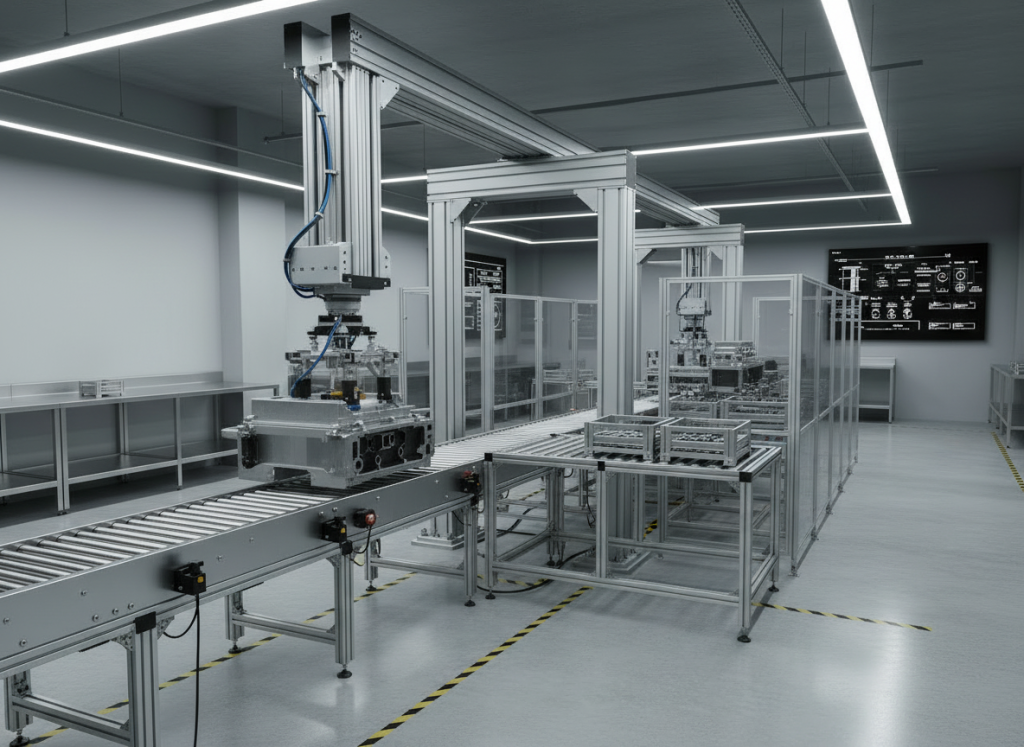
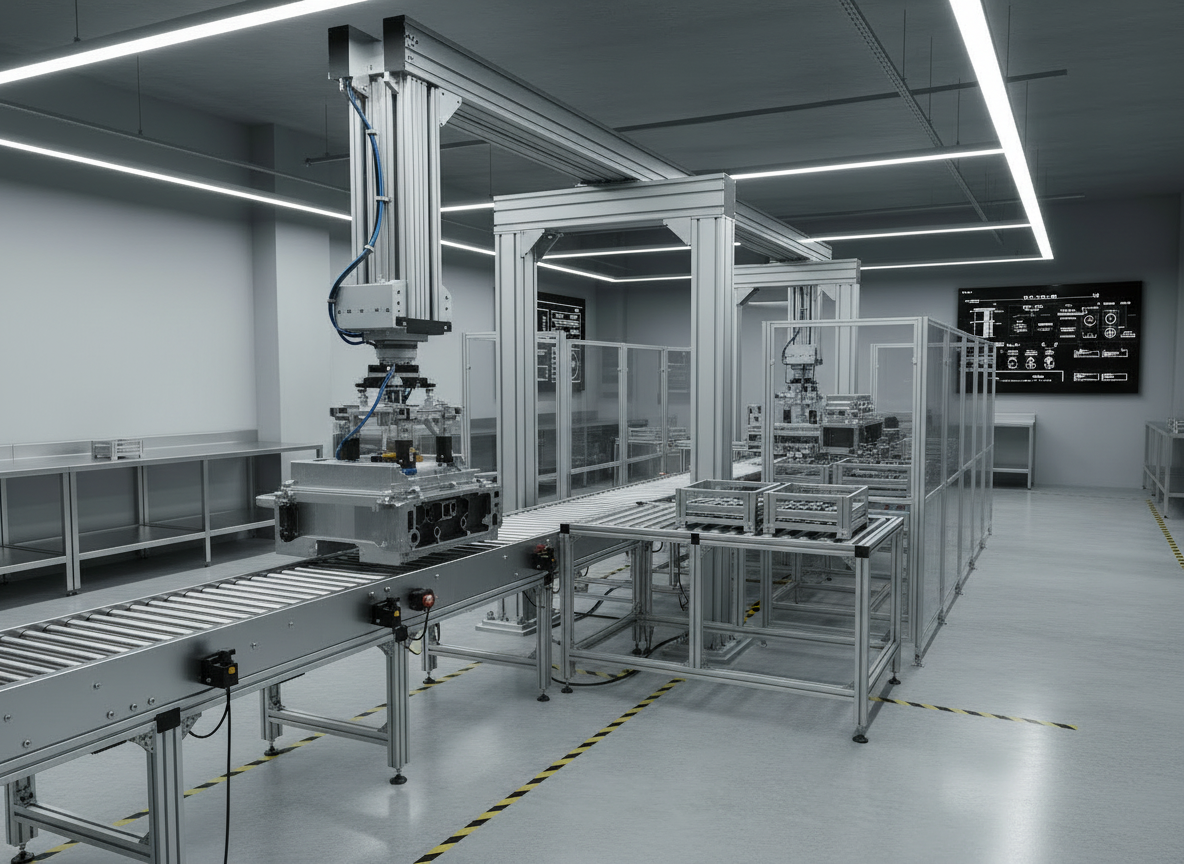
As manufacturers continue to pursue faster production, improved precision, and greater operational efficiency, automation systems have become an essential part of modern industrial environments. While articulated robotic arms often receive the most attention, gantry and Cartesian robot systems remain some of the most reliable and effective automation solutions for large-scale material handling, precision movement, and high-payload applications.
Known for their rigid structure, scalable design, and exceptional repeatability, gantry and Cartesian systems are widely used across manufacturing, packaging, warehousing, and assembly operations. These systems provide controlled linear movement that allows manufacturers to automate repetitive processes with high levels of accuracy and consistency.
For applications requiring long travel distances, heavy payloads, or structured movement paths, gantry and Cartesian robots often provide advantages that traditional robotic arms cannot match.
What Are Gantry and Cartesian Robot Systems?
Gantry and Cartesian robots are automation systems that operate using linear motion along multiple axes. Unlike articulated robots that rotate around joints, Cartesian systems move along straight-line paths using X, Y, and Z coordinates.
Because movement occurs across fixed linear axes, these systems are often referred to as linear robots.
A standard Cartesian robot typically includes:
- X-axis movement (horizontal travel)
- Y-axis movement (cross travel)
- Z-axis movement (vertical travel)
Some systems also include additional rotational axes for product orientation and positioning flexibility.
Gantry systems are a larger form of Cartesian automation, typically mounted above the workspace on an overhead framework. These systems are designed for applications requiring large work envelopes, long travel distances, or heavy lifting capabilities.
Their rigid mechanical structure provides exceptional stability and repeatability, making them ideal for demanding industrial environments.
Why Manufacturers Use Gantry and Cartesian Systems
Gantry and Cartesian robots offer several major advantages in industrial automation, particularly for applications involving predictable motion paths, heavy products, or large work areas.
Key benefits include:
- High payload capacity
- Excellent positional accuracy
- Large working envelopes
- Repeatable linear movement
- Simplified programming
- Scalable system design
- Efficient use of floor space
Because these systems operate on structured linear paths, they often provide highly efficient automation for repetitive transfer and positioning applications.
Key Benefits of Gantry and Cartesian Robots
High Payload Capacity
One of the biggest advantages of gantry systems is their ability to handle heavy loads. Their rigid frame structure allows them to move large products and assemblies with stability and precision.
Applications involving large pallets, industrial components, sheet materials, or bulk product transfer often require payload capacities beyond what smaller articulated robots can efficiently handle.
Gantry systems are commonly used for:
- Heavy palletizing
- Large-part transfer
- CNC machine loading
- Warehouse automation
- Industrial material handling
Their structural stability allows them to maintain consistent performance even under demanding operating conditions.
Large Work Envelopes
Unlike many robotic arms with limited reach ranges, gantry and Cartesian systems can be designed to cover extremely large work areas.
This makes them ideal for:
- Multi-station production lines
- Large conveyor systems
- Warehouse applications
- Oversized assembly operations
- Long-distance transfer systems
Because the robot travels across rails or structural beams, the work envelope can often be expanded to fit the application rather than being limited by robot arm geometry.
Exceptional Accuracy and Repeatability
Precision is critical in industrial automation, particularly in assembly, machining, and positioning applications.
Cartesian systems excel in environments requiring highly repeatable linear movement because each axis operates independently along controlled paths.
This design allows for:
- Precise positioning
- Consistent product placement
- Accurate machine loading
- Repeatable cycle performance
- Stable handling during high-speed movement
The rigid frame structure also reduces vibration and unwanted movement, improving overall system accuracy.
Efficient Use of Floor Space
Many gantry systems are mounted overhead, allowing valuable floor space beneath the system to remain open for conveyors, workstations, operators, or additional automation equipment.
This overhead configuration is especially beneficial in facilities where floor space is limited or production layouts are already densely packed.
By utilizing vertical space, manufacturers can improve workflow efficiency without significantly expanding facility footprints.
Simplified Motion Control
Because Cartesian robots move along straight linear axes, programming and motion control are often simpler than with more complex articulated robots.
For repetitive transfer applications, this can result in:
- Faster implementation
- Easier troubleshooting
- Simplified maintenance
- Reliable motion consistency
This simplicity can also improve long-term reliability in applications with predictable movement paths.
Common Applications for Gantry and Cartesian Systems
Material Handling
Material handling is one of the most common uses for gantry automation.
These systems are frequently used to:
- Transfer products between conveyors
- Load and unload pallets
- Move heavy assemblies
- Position materials for processing
- Organize products for packaging
Automating material handling processes improves throughput while reducing repetitive manual labor.
CNC Machine Tending
Gantry systems are widely used in machining environments where parts must be loaded and unloaded from CNC equipment.
Their precision and repeatability make them ideal for:
- Multi-machine tending
- Large-part machining
- Continuous production operation
- Automated part transfer
By synchronizing robotic movement with machining cycles, facilities can reduce idle time and improve machine utilization.
Palletizing and Depalletizing
Heavy-duty gantry robots are commonly used for palletizing applications involving large products or high payload requirements.
These systems can:
- Build consistent pallet patterns
- Handle oversized products
- Operate across multiple pallet stations
- Integrate with conveyor systems
Because of their large work envelopes, gantry palletizers are often used in high-volume industrial environments.
Warehouse and Logistics Automation
Warehouse automation increasingly relies on gantry-style systems for product movement and storage handling.
Applications may include:
- Automated storage and retrieval systems (AS/RS)
- Inventory transfer
- Package sorting
- Distribution center automation
These systems help improve order fulfillment speed while reducing labor-intensive handling processes.
Assembly Automation
Cartesian robots are frequently used in assembly operations requiring accurate positioning and repeatable linear motion.
Applications may include:
- Component insertion
- Adhesive dispensing
- Precision fastening
- Product positioning
- Multi-stage assembly processes
Their controlled movement paths provide excellent consistency for precision manufacturing tasks.
End-of-Arm Tooling (EOAT)
Like other robotic systems, gantry and Cartesian robots rely heavily on properly designed end-of-arm tooling.
EOAT options may include:
- Vacuum grippers
- Mechanical clamps
- Magnetic tooling
- Servo-driven grippers
- Custom handling tools
The tooling is designed specifically around the product, handling requirements, and cycle time goals of the application.
In many systems, tooling also incorporates sensors or vision systems to improve positioning accuracy and process verification.
Vision Systems and Smart Automation
Modern gantry systems increasingly integrate machine vision and advanced sensing technologies to improve flexibility and reliability.
Vision systems allow robots to:
- Detect product position
- Verify orientation
- Inspect for defects
- Track conveyor movement
- Confirm assembly accuracy
These technologies improve system adaptability and reduce the need for manual product staging.
Advanced automation systems may also incorporate real-time monitoring, production analytics, and predictive maintenance capabilities to improve long-term operational performance.
Integration with Existing Production Lines
One of the most important considerations in automation projects is how well the system integrates into existing operations.
Gantry and Cartesian systems are highly adaptable and can be integrated with:
- Existing conveyors
- Packaging equipment
- CNC machines
- Inspection systems
- PLC controls
- Warehouse management systems
Their modular design allows manufacturers to automate targeted sections of production without requiring complete facility redesigns.
This flexibility helps reduce downtime during implementation while improving overall production efficiency.
Industries Using Gantry and Cartesian Automation
These systems are widely used across industries requiring heavy-duty handling, precision positioning, or large-area automation.
Common industries include:
- Automotive manufacturing
- Food and beverage processing
- Warehousing and logistics
- Industrial manufacturing
- Packaging operations
- Aerospace manufacturing
- Agricultural processing
- Consumer packaged goods (CPG)
As production demands continue to grow, more facilities are implementing gantry automation to improve throughput, consistency, and scalability.
The Future of Gantry Automation
As industrial automation technology advances, gantry and Cartesian systems continue evolving with improved motion control, sensing technologies, and data integration capabilities.
Modern systems increasingly incorporate:
- AI-assisted vision systems
- Real-time production monitoring
- Predictive maintenance tools
- Advanced servo control
- Remote diagnostics
- Smart factory integration
These developments are helping manufacturers create more connected, efficient, and adaptable production environments.
Final Thoughts
Gantry and Cartesian robot systems remain some of the most effective automation solutions for industrial applications requiring precision, scalability, and heavy-duty performance.
Their combination of large work envelopes, high payload capacity, and repeatable linear movement makes them ideal for material handling, palletizing, machining support, warehouse automation, and assembly operations.
For manufacturers seeking reliable automation capable of supporting long-term production growth, gantry and Cartesian systems provide a durable and highly efficient solution that continues to play a major role in modern industrial automation.