
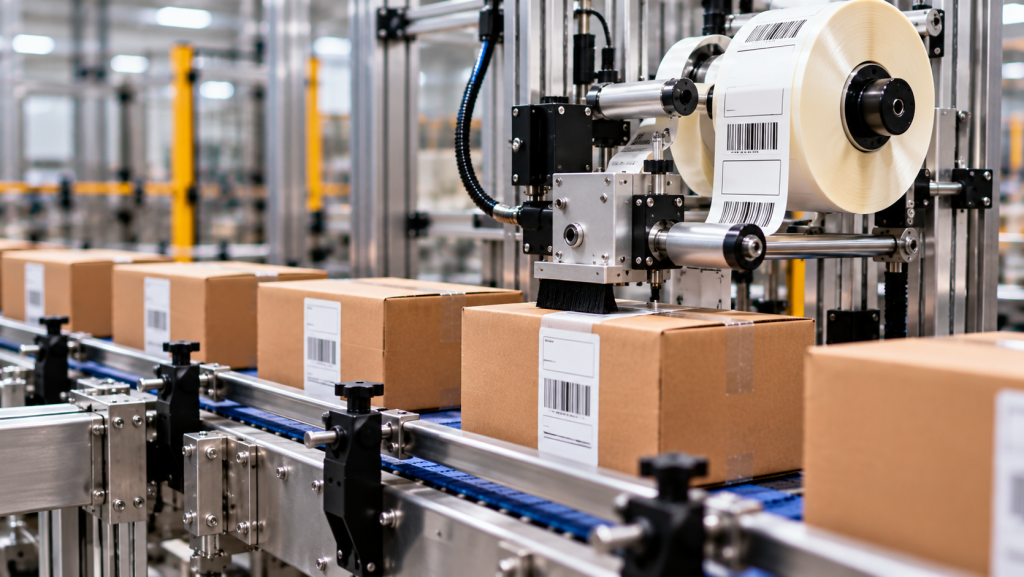
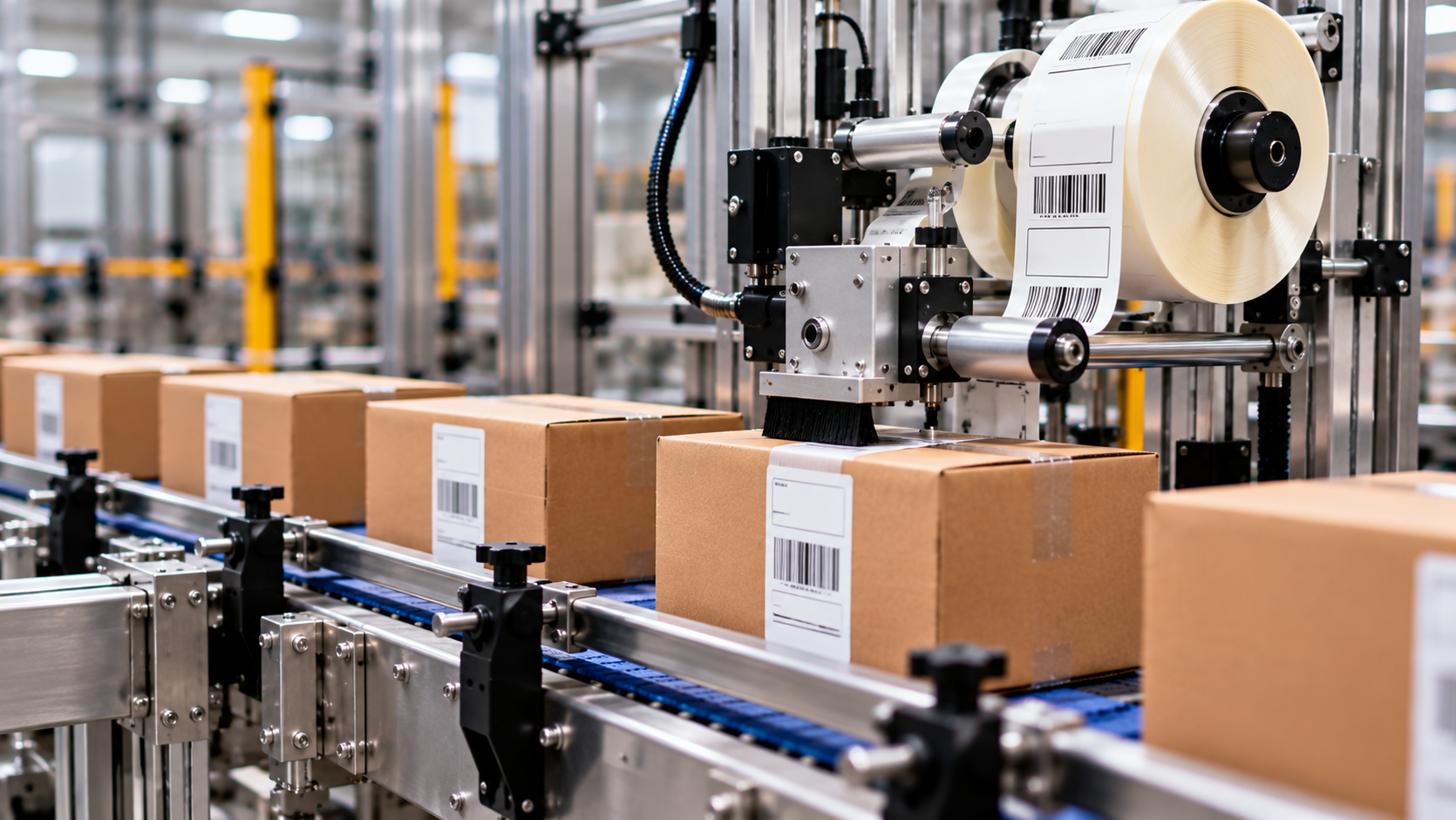
Every product that leaves a manufacturing facility needs to be identified, tracked, and prepared for its next destination. Whether it’s a barcode on a shipping case, a product label on a bottle, or a tracking label on a pallet, labeling plays an important role in keeping production and distribution moving efficiently.
But as production speeds increase, manual labeling can become a challenge.
Misplaced labels, incorrect product information, and inconsistent application can create unnecessary delays and costly rework. That’s why more manufacturers are turning to Automated Labeling Systems to improve accuracy, streamline operations, and maintain consistent production speeds.
At SynerTech Automation, we help manufacturers integrate automation technologies into their operations, creating more connected and efficient production processes.
What Is Labeling Automation?
Labeling automation uses specialized equipment to apply labels to products, containers, boxes, cases, and pallets with minimal manual intervention.
Instead of requiring an employee to individually position and apply each label, automated equipment coordinates product movement, label dispensing, and application.
Depending on the production requirements, labeling systems may use sensors, conveyors, programmable controls, and machine vision technology to ensure labels are applied in the correct location.
These systems can handle several types of labeling applications, including:
- Product identification labels
- Barcode and QR code labels
- Shipping and logistics labels
- Lot numbers and batch information
- Case and pallet identification
- Retail packaging labels
The goal is to create a repeatable process that supports both production efficiency and accurate product identification.
How Do Automated Labeling Systems Work?
Although equipment configurations vary, most automated labeling processes follow a similar sequence.
First, products move along a conveyor or are positioned at a labeling station. Sensors detect the product’s presence and help determine when the label should be applied.
Next, the labeling equipment dispenses a preprinted label or prints information in real time.
An applicator then transfers the label onto the product or package. Depending on the application, the label may be applied using a wipe-on mechanism, tamp pad, air-assisted applicator, or other specialized technology.
Some systems also incorporate barcode scanners or vision inspection equipment to verify that labels are present, readable, and correctly positioned.
Once labeling is complete, products continue through the production line toward packing, palletizing, or distribution.
By integrating these steps into a single process, manufacturers can reduce manual handling while maintaining consistent labeling performance.
The Benefits of Automating Your Labeling Process
1. Improved Labeling Accuracy
Incorrect or poorly positioned labels can cause problems throughout the supply chain.
Automated equipment applies labels according to programmed settings, helping maintain consistent placement across large production volumes.
When paired with barcode verification or machine vision technology, labeling systems can also help identify missing, unreadable, or incorrect labels before products move downstream.
2. Increased Production Efficiency
Manual labeling can struggle to keep pace with high-volume production lines.
Automated Labeling Systems can operate at speeds matched to the surrounding equipment, helping prevent labeling from becoming a production bottleneck.
This is especially valuable in facilities where products move continuously through packaging and distribution processes.
3. Reduced Manual Labor
Labeling individual products or shipping cases can require repetitive movements throughout a shift.
Automation reduces the amount of hands-on work required for these tasks, allowing employees to focus on equipment operation, quality assurance, and other responsibilities.
It can also help reduce repetitive handling demands in high-volume environments.
4. Better Product Traceability
Labels carry important information that allows products to be identified and tracked.
Barcodes, serial numbers, and batch identifiers can connect physical products to inventory management and production records.
When labeling equipment is integrated with manufacturing software, the system can receive the correct data for each product or production run.
Standards developed by GS1 US help businesses establish consistent product identification and barcode practices across the supply chain.
5. More Consistent Packaging Quality
A label may seem like a small detail, but it contributes to the overall quality and professionalism of finished packaging.
Automated application helps maintain consistent placement and presentation, particularly when large quantities of products must meet the same packaging specifications.
Common Types of Industrial Labeling Automation
Different manufacturing environments require different labeling technologies.
Print-and-Apply Labeling
Print-and-apply systems generate labels with variable information, such as barcodes, shipping details, or serial numbers, and apply them directly to products or packaging.
These systems are commonly used for shipping cases, cartons, and pallets.
Pressure-Sensitive Labeling
Pressure-sensitive labeling equipment applies adhesive-backed labels to products and containers.
This method is frequently used for bottles, jars, cartons, and consumer goods.
Robotic Labeling
Robotic labeling systems use industrial robots to position labels or label applicators around products.
Robots can be useful for applications requiring access to different surfaces, unusual product shapes, or integration with robotic handling processes.
Label Inspection and Verification
Vision systems and barcode scanners can inspect labels after application.
These technologies help manufacturers confirm label presence, positioning, and readability. More advanced systems can compare printed information against expected production data.
Which Industries Benefit From Labeling Automation?
Automated labeling can support a wide range of manufacturing applications.
Food and Beverage: Labels may identify products, ingredients, production batches, and expiration dates. Labeling systems must be designed around the product and applicable labeling requirements.
Consumer Products: Personal care products, cleaning supplies, cosmetics, and household goods often require consistent label placement across multiple SKUs.
Warehouse and Logistics: Shipping labels, barcodes, and pallet identification help support inventory tracking and order fulfillment.
Industrial Manufacturing: Parts, components, and finished assemblies may require identification labels for inventory control and traceability.
Regardless of the industry, labeling automation should be designed around the specific product, packaging material, and production environment.
Integrating Labeling With End-of-Line Automation
Labeling is often one part of a larger packaging process.
Products may move from assembly or filling into labeling, inspection, case packing, and palletizing before reaching distribution.
When these operations function independently, manufacturers may experience unnecessary product handling, inconsistent speeds, and communication gaps between equipment.
Integrating labeling with conveyors, sensors, programmable controls, and downstream packaging machinery creates a more coordinated operation.
For example, a shipping case could move through an automated packing station, receive a printed barcode label, pass through a verification scanner, and continue directly to robotic palletizing.
The result is a connected workflow that helps products move through the facility with fewer manual touchpoints.
Industry organization PMMI provides additional resources on packaging technologies and manufacturing automation.
What Should You Consider Before Automating Labeling?
Before investing in labeling equipment, manufacturers should evaluate their current production process.
Important considerations include product dimensions, packaging materials, labeling locations, production speeds, and the number of different products handled.
Facilities should also determine whether labels contain fixed information or require variable data from an inventory management or production system.
Additional questions include:
- How frequently do products or label formats change?
- Is barcode scanning or label verification required?
- Will labeling equipment need to communicate with existing machinery?
- Are products presented consistently to the labeling station?
- What maintenance and operator access will the system require?
Answering these questions early helps identify the right equipment and integration strategy.
Why Work With SynerTech Automation?
Successful labeling automation requires more than selecting a label applicator. It requires understanding how the equipment will function within the larger production process.
At SynerTech Automation, we focus on developing integrated automation solutions that support efficient manufacturing operations.
From robotic handling and conveyors to machine vision and control system integration, our approach considers how individual technologies work together.
Whether you’re upgrading an existing packaging line or exploring a new automated process, our team can help evaluate solutions tailored to your production goals.
Make Labeling a More Efficient Part of Your Production Line
Labeling may be one of the final steps in manufacturing, but its impact extends throughout the supply chain.
With the right automation equipment, manufacturers can improve label consistency, reduce repetitive work, support traceability, and keep products moving efficiently toward distribution.
Ready to explore labeling automation for your facility?
Contact SynerTech Automation to discuss your application and discover how a custom automation solution could support your operation.